
VIDEO BRIEF
1.What is your chosen digital media context (choose one, it can also be a hybrid of two- for example AI and Surveillance are commonly paired together. Another option would be the rise of VR and the resulting digital divides between people who can afford and those who can’t)- Surveillance, VR/AR, Artificial Intelligence, Digital divides
– My chosen topic is:’ The rapid spread of AI’s practical applications is not only occurring for different reasons, but also entails different implications’.
2. What’s the goal of this video? Why are you making the video in the first place?
The aim of this video is to access to more in-depth information about AI, what benefits can AI brings to the human community, what advantages and disadvantages AI has, especially in the Education industry.
3. Who is your intended audience for this video? Who are they? What are their media consumption patterns like? Who or what is influential in their culture subculture? What motivates them (gets them out of bed each morning?
My target audiences are the people who are interested in digital technology and attempt to discover the AI’s practical applications.
4.You will need to base your video on at least 5 x research sources. You must directly cite academic and scholarly reading and research within your video using 5 different sources (2 academic, 1 news, 1 forum, 1 video). This means you have to draw on (paraphrase or direct quotation) 5 different sources of scholarly reading and research in your narration.
References:
Academic (1):
Jennings, C 2019, Artificial Intelligence: Rise of the Lightspeed Learners, Rowman & Littlefield Publishers, retrieved 4th June 2020, <https://ebookcentral-proquest-com.ezproxy-b.deakin.edu.au/lib/deakin/reader.action?docID=5760378>
News (1):
Bonderud, D 2019, Artificial Intelligence, Authentic Impact: How Educational AI is Making the Grade, EdTech, retrieved 4th June 2020 <https://edtechmagazine.com/k12/article/2019/08/artificial-intelligence-authentic-impact-how-educational-ai-making-grade-perfcon>
Forum (2) – YouTube’s comments:
How China Is Using Artificial Intelligence in Classrooms 2019, video recording, Wall Street Journal, New York City. <https://www.youtube.com/watch?v=JMLsHI8aV0g>
Neuroscience, AI and the Future of Education | Scott Bolland 2016, video recording, TedTalk <https://www.youtube.com/watch?v=_cYIvfS-knA>
Videos (2):
How China Is Using Artificial Intelligence in Classrooms 2019, video recording, Wall Street Journal, New York City. <https://www.youtube.com/watch?v=JMLsHI8aV0g>
Neuroscience, AI and the Future of Education | Scott Bolland 2016, video recording, TedTalk <https://www.youtube.com/watch?v=_cYIvfS-knA>
5.Look for at least 2/3 examples on YouTube for videos with similar content. Pay attention to how the videos were structured.
How China Is Using Artificial Intelligence in Classrooms 2019, video recording, Wall Street Journal, New York City. <https://www.youtube.com/watch?v=JMLsHI8aV0g>
Neuroscience, AI and the Future of Education | Scott Bolland 2016, video recording, TedTalk <https://www.youtube.com/watch?v=_cYIvfS-knA>
6.Look for at least 2/3 examples on YouTube for videos that inspired you aesthetically- inspiring work both in terms of sight and sound. Pay attention to cinematography, the edit, and the interplay between voice, music, sound effects and BGM.
Example:
Modern & clean CINEMATIC TITLES inside Premiere Pro <https://www.youtube.com/watch?v=3-XRSfWIG7I>
Video in Text Movie Title Intro inside Premiere Pro: Adobe Premiere Pro TUTORIAL <https://www.youtube.com/watch?v=Hf-zHkDBAOM>
How to Edit a Documentary – Phil Ebiner’s Process <https://www.youtube.com/watch?v=lFW30oBFhN8>
BMG:
Lavish 2020, GCBeats, < https://gcbeats1.beatstars.com/beat/lavish-4232740>
7.Next we think about the objective of our video. What is your approach to the topic?
a) expository to describe or explain a topic
– In the second assignment, we were asked to produce a video with similar topics but more generally. In this assignment, the topic needs to be more specifically with a certain target, which is how AI’s applications could affect humanity.
b) analytical to break down a topic into parts, and then exploring the relationships between each part
– The video consists two main parts: the advantages of AI in education and the disadvantages of AI in education, taking China as an example. The two parts provided the audience both point of views and let them make comparison.
c) persuasive to change or reform attitudes, opinions, behaviors, values, worldview through voluntary compliance.
d) argumentative to provide a set of reasons to support a point of view, truth or theory. Or to challenge the degree of truth in another statement, truth, or point of view.
– After reading the comments on the YouTube site, I got a more general look on this topic, since I have always been on the side where I support AI’s practical use without any doubt.
8. What are the key takeaways of the video? What should viewers learn from watching it?
– AI could be very dangerous if humans rely too much on it, conceivably in the future, humans and robots will probably have to depend on each other rather than humans controlling robots. Students need to be developed to the fullest, not because of their achievements but to turn themselves into robots.
9. What’s your call-to-action? What do we want your viewers to do after they’ve finished watching the video? To support a cause, to click on a link, to watch another video, to read a book, etc.
– AI is a huge leap forward for humanity, it really helps us with a lot of things like education, economy, culture and health. But if we misuse it or use it in the wrong way, it is likely that the situation will be reversed in the future, humans will be victims of AI.
REFLECTION
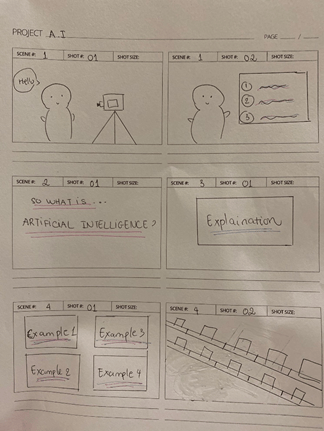
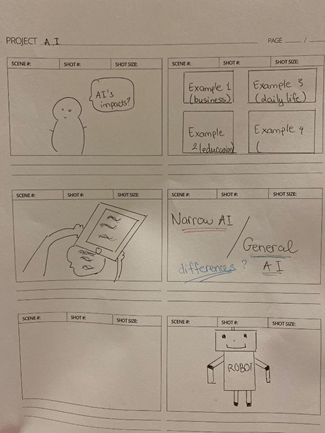
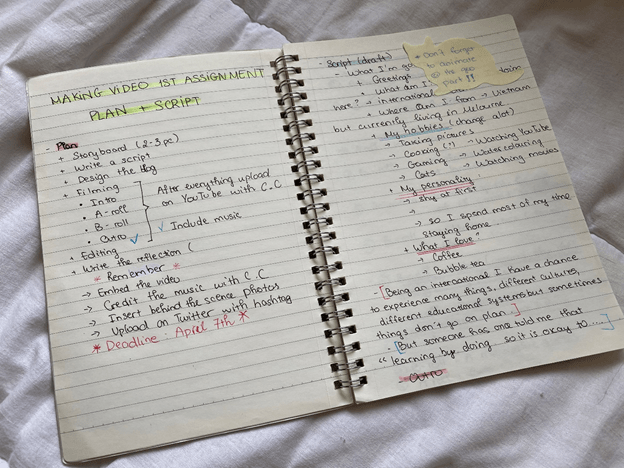
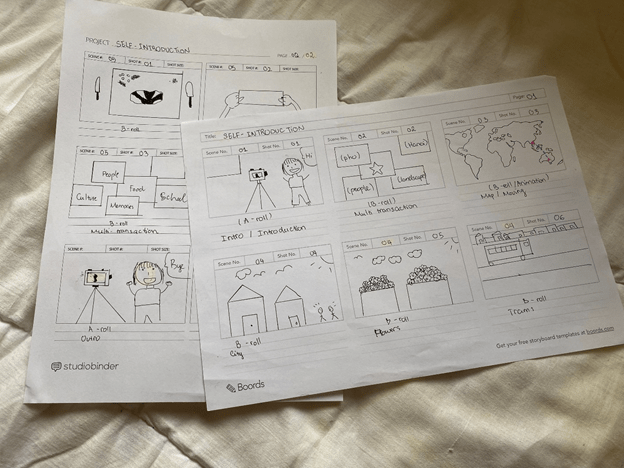
To meet the assignment’s requirements of making a 7-minute long educational video, I first started off by making a detailed plan on what contents I need to bring into the video, how I am going to do and a checklist of things that need to be done. Although there are several ways to start a plan but personally, I prefer writing them down by hand, it helps me to add more words or fix mistakes in the easiest way.
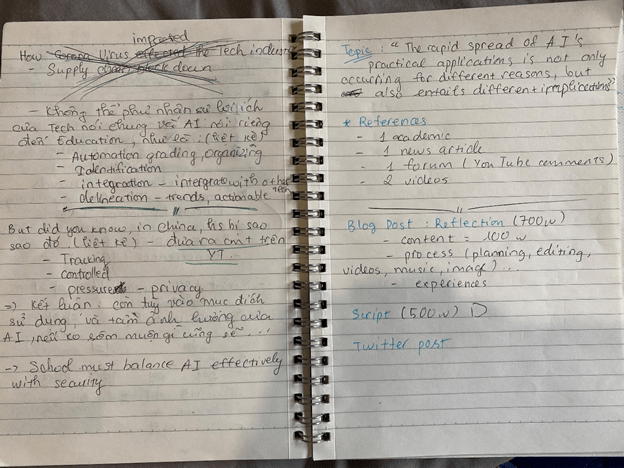
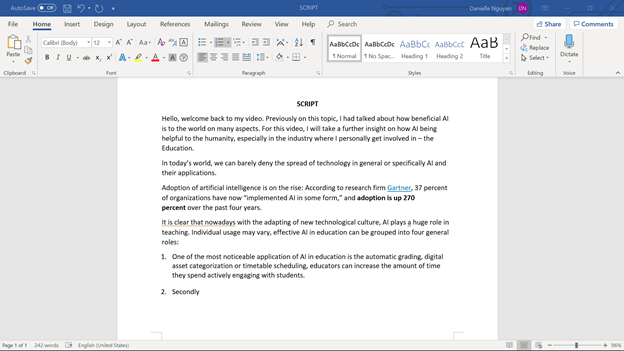
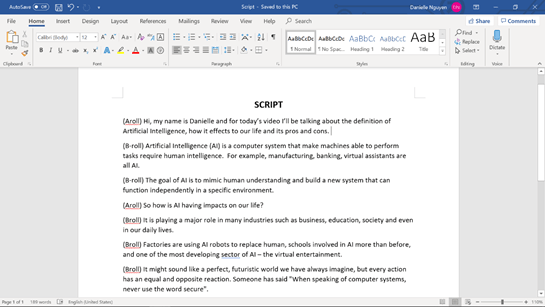
After finishing the plan, I started writing a script based on what I have learned then took references from the resources I have mentioned above. To complete the process of preparing, I practiced reading the script for few times then started recording myself reading the script using my phone. Then I transferred the audio file to my computer and use it as a editing material.
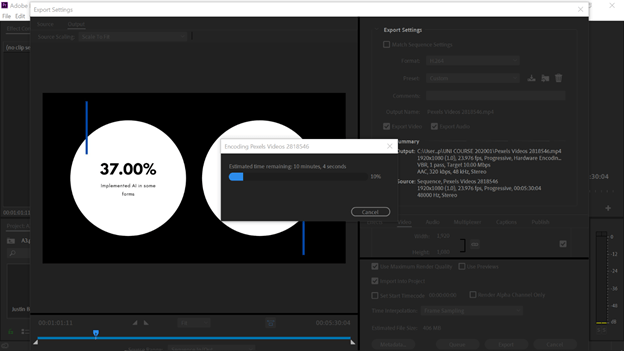
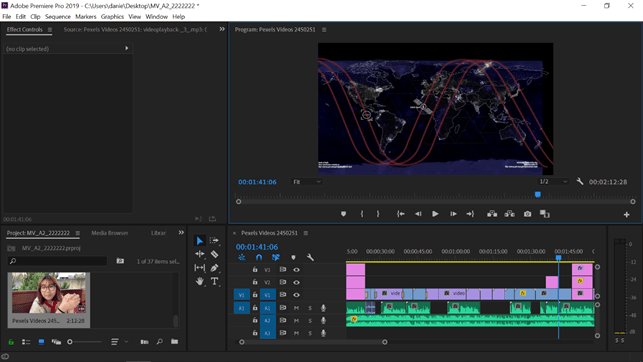
The visual materials I used in my video are from a website called Pexels. They provide an absolutely free large number of images and videos to serve the purpose of study and work. I have downloaded many videos with related keywords such as “Technology”, “Artificial Intelligence”, “Education” and use them to edit by a software called Adobe Premiere Pro, which I found suitable for both beginning and expert editors. Eventually, the background music that I chose in the video is called “Lavish” by CGBeats was under Creative Commons Licenses (CC BY-SA 4.0).











 DANIELLE'S BLOG